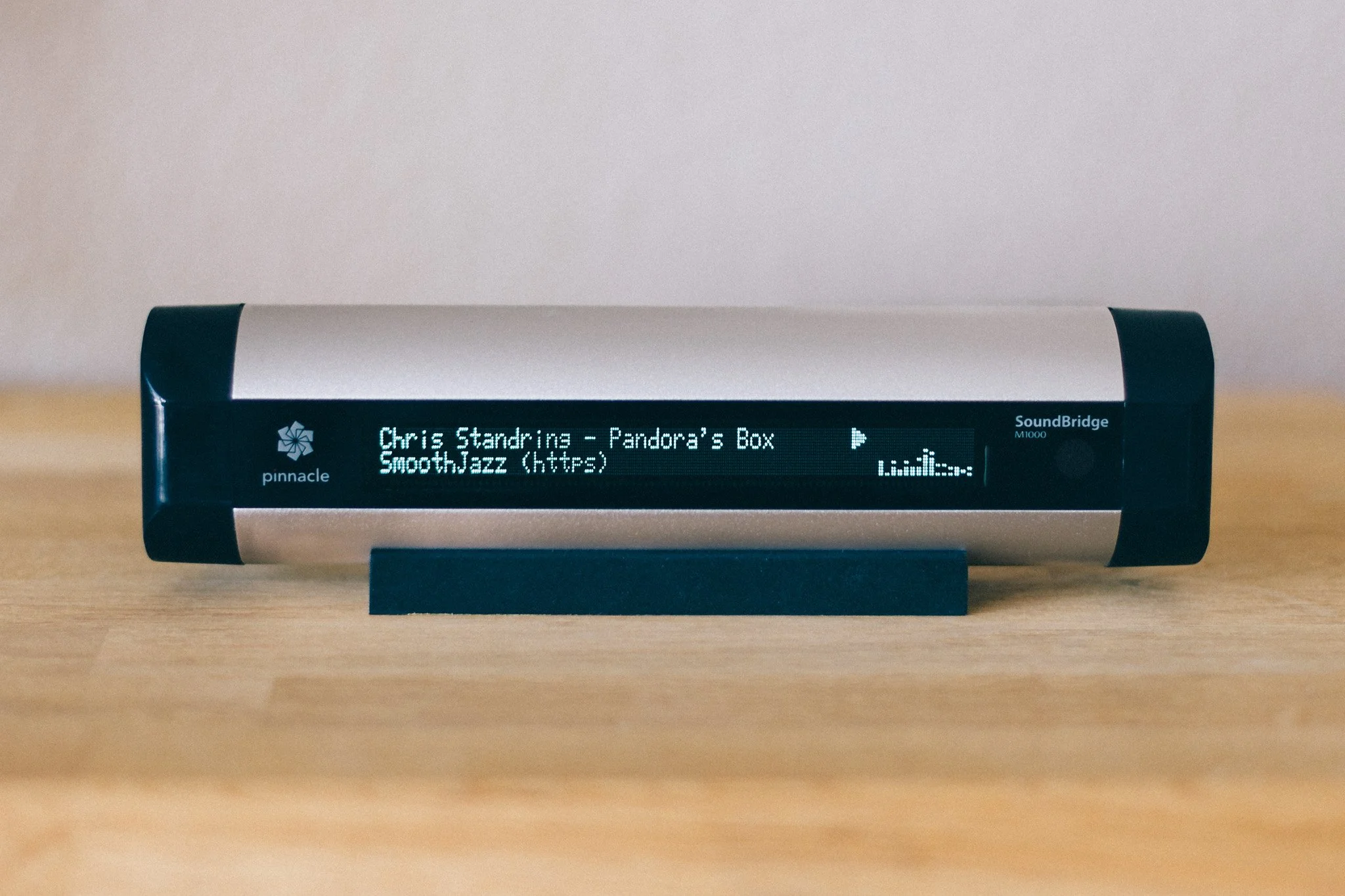
Still in use.
There are some devices that, even many years after their introduction, still make you wonder why nothing comparable is available anymore. For me, the Roku SoundBridge is definitely one of them!
I use the SoundBridge as a network music player connected to my stereo system. The device comes from a time when networked music was still something rather special, and streaming services as we know them today were still far from being part of everyday life. And yet, the basic concept behind the SoundBridge still feels surprisingly modern.
What I particularly like, especially compared with many modern streaming devices, is this clear separation of functions. The SoundBridge does not try to be a television, voice assistant, smart home hub, and cloud terminal all at once. It is a network music player. And that is precisely what makes it so interesting even today.
Ahead of its time.
With the SoundBridge, Roku had created a device that was remarkably well designed, both technically and conceptually, for its time. The first generation consisted of three models: the M500, M1000, and M2000. The three models were closely related technically and differed primarily in the type and size of their displays, as well as in their respective enclosure sizes.
The M500 did not have a graphics-capable VFD display and was therefore the simpler version. The M1000, by contrast, featured a large, graphics-capable VFD display that was remarkably impressive for a network music player of its era. The M2000 was larger still and correspondingly more expensive, but offered a display that remained easy to read even from a greater distance.
And that excellent display is, for me, still an essential part of the SoundBridge's character. While many modern streaming devices display information primarily through a smartphone app, the SoundBridge itself can show the currently playing track, the artist, or the selected source. It feels like a genuine standalone Hi-Fi component rather than a small network adapter whose actual user interface happens to live on a smartphone.
The first generation has, of course, long since become a piece of technology history. Even back then, the models were gradually replaced by the second generation. Today, M500, M1000, and M2000 units can generally only be found used, with the occasional old remaining stock turning up here and there.
The second generation included the M1001 as the successor to the M1000. Interestingly, Roku initially marketed the M1001 in some cases under the M1000 name as well, even though there are genuine differences between the two devices. They look very similar from the outside, but the M1001 has a somewhat different set of connections, with the connectors conveniently located on the rear panel.
The SoundBridge was also manufactured under license by Pinnacle for a time, particularly for markets outside North America. The Roku and Pinnacle units were essentially identical, although there was one important difference when it came to support for Apple's DAAP protocol: Pinnacle did not have a DAAP license from Apple. As a result, a Pinnacle SoundBridge could not directly access Apple iTunes shares or other DAAP servers. For iTunes users, however, Firefly provided a very good alternative server solution that was useful for more than just this particular purpose.
First & second generation - technically different.
The differences between the first and second generations were not limited to the enclosure, connectors, and features. The second-generation SoundBridge models, including the M1001, were based on a different audio architecture than the first-generation M500, M1000, and M2000.
The first generation in particular was appreciated by more demanding listeners for its audio quality. It also offered features such as HDCD support and DTS passthrough that were no longer available in the same form on the later models. Some owners therefore considered the audio quality of the second generation to be less impressive. At the same time, the new audio architecture was one of the reasons Roku was able to offer the devices at a significantly lower price. For most users, however, the sound quality remained more than adequate.
The second generation brought other advantages in return. It had a larger flash ROM, and Wi-Fi was built in. Firmware 2.7 also added WPA support, while the first generation was limited to WEP for wireless networking. The second generation was therefore not simply a technically inferior version of the original devices, but rather a further development with a different focus: lower cost, more modern networking capabilities, and a broader target audience.
Hardware - focused on the essentials.
Another thing I like about the SoundBridge is its remarkably straightforward and purposeful design. The device was not overloaded with as many features as possible, but instead focused on its actual purpose: receiving music over the network, processing it, and delivering it in good quality to a stereo system.
For music playback itself, the SoundBridge does not need a hard drive, an optical drive, or a fan. There are no mechanical components that have to be constantly moving during normal playback.
The SoundBridge connects to a music server or other source over a TCP/IP network. It processes the data and then outputs the music through its various audio connections. Depending on the model, this could be done via Ethernet or Wi-Fi. On the classic M-series models, the connection to the stereo system could then be made either via analog RCA or digitally through an optical or coaxial output, making the SoundBridge particularly interesting for a high-quality Hi-Fi setup. The analog output was also quite good. Personally, I have always found the overall sound quality excellent, and in comparison with older CD players connected via analog outputs, the SoundBridge actually sounded better to my ears.
Of course, this straightforward design does not mean that a device more than twenty years old is automatically free from age-related issues. Electronic components age, power supplies can eventually develop problems, and even a VFD display will not remain as bright and contrast-rich as it was on the first day. The underlying concept, however, is remarkably durable. The SoundBridge was not built around a short-lived online platform, but as a standalone network music player.
That technical simplicity is also part of its appeal for me. Essentially, it needs power, a network connection, and a connection to the audio system. For a device whose sole purpose is to play music, that is actually a remarkably well-defined job description.

SoundBridge & Internet Radio
With later firmware versions, the SoundBridge also became particularly interesting as an Internet radio player. Starting with firmware 3.0, Roku integrated an online database containing a large number of radio stations, allowing users to search for stations and select them directly on the device. At the time, this was an exceptionally convenient solution.
There was no need to search for a stream on a computer, copy its address, and then somehow transfer it to the stereo system. The SoundBridge could search for radio stations itself and play the selected station directly.
The station database, however, was also a service external to the hardware itself. If the RadioRoku server was unavailable, new radio stations could not be selected through the database. Stations that had already been saved remained available, however. The SoundBridge provides 18 presets, allowing radio stations to be stored directly on the device and recalled even when the online database was unavailable.
At the time, this was an extremely practical solution. It also illustrates a problem that only became apparent years later with many devices from this generation: hardware can remain functional for far longer than the services it was originally designed to depend on.
Limitations in today's world.
Of course, by today's standards the SoundBridge is no longer a modern streaming device. It does not support the wide range of current streaming services that people expect from today's products, and its firmware has not received any major development for many years.
Modern HTTPS streams - big problem!
When the SoundBridge was developed, the technical requirements for Internet streaming were considerably simpler. HTTP-based audio streams were widespread, and communication between client and server was correspondingly straightforward.
Today, the situation is different. HTTPS has long since become the standard, and modern streaming servers use TLS encryption, current certificates, and protocols that network software from that era does not necessarily support.
For a modern computer, this is usually not a problem. Browsers and operating systems take care of certificates, encryption, and the latest protocol versions. Smartphones and modern streaming devices are also regularly updated and can therefore adapt to changes on the server side.
A SoundBridge naturally does not have the same ability to adapt. Its firmware comes from a different technological era and has not been updated for a long time to reflect the continued evolution of the Internet. The SoundBridge supports a surprisingly broad range of networking technologies for a device of its age, including WEP, WPA, AutoIP, DHCP, TCP, Telnet, HTTP and DRM. What it does not support, however, is HTTPS.
That missing HTTPS support is particularly significant today. The SoundBridge can communicate perfectly well over a TCP/IP network and can establish HTTP connections to streaming servers, but it cannot itself establish the modern TLS-encrypted HTTPS connections that have become standard on the Internet.
The last firmware updates were essentially limited to smaller fixes and adjustments, for example when changes were made to other services or protocols. There was therefore no later firmware development that could bring the SoundBridge's networking capabilities in line with the modern HTTPS-based Internet.
As a result, a stream can work perfectly well on a modern computer and still fail to play directly on the SoundBridge. The SoundBridge itself is not necessarily the problem. It can still reproduce audio extremely well, and it can still establish network connections. The difficulty arises where the capabilities of an older client meet the requirements of a modern streaming server.
At some point, that left me with an obvious question: Could this problem be solved without modifying the SoundBridge itself?
The solution - a proxy server.
The answer was surprisingly simple: the SoundBridge does not have to establish the modern HTTPS connection itself.
If a small server on the local network handles the connection to the Internet radio station, that server can take care of the technical requirements of the modern streaming server. It can then provide the SoundBridge with a stream that it can process using its existing capabilities.
This does not modernize the SoundBridge itself. Instead, it simply adapts the connection between the old hardware and the modern Internet.
For this purpose, NGINX was a natural choice. NGINX is a powerful web server and reverse proxy that is well suited to establishing a connection to a remote server and forwarding the resulting data stream to another client.
The basic setup is quite simple. The SoundBridge connects to a local HTTP address. NGINX accepts that connection and establishes an HTTPS connection to the actual radio station in the background. The incoming audio stream is then forwarded to the SoundBridge without unnecessary buffering.
In this way, the SoundBridge can continue to work with its existing network protocols, while NGINX handles the modern HTTPS connection to the radio station in the background.
First working solution.
Once the basic idea for the proxy had been established, the next step was to turn it into a working solution. I therefore decided not to install NGINX directly on the host system, but to run it inside a Docker container. NGINX does not require a complex environment and can be operated completely separately from the actual system installation. The required configuration, ports, and runtime environment of the proxy are therefore contained within a clearly isolated container. If the configuration needs to be changed later, or the proxy needs to be rebuilt completely, the underlying system remains largely unaffected.
Another advantage is easy reproducibility. The NGINX configuration can be managed independently of the underlying operating system. The container can be stopped, restarted, or recreated whenever necessary, without having to manually reinstall and configure NGINX on the host each time.
For managing the container, I used Portainer. Its graphical interface is extremely convenient, although Portainer is by no means required - Docker can of course be managed entirely from the command line. For a small home server, however, having a graphical interface makes administration considerably more convenient.
The actual NGINX configuration for this first solution consisted of two files. The first file defined the basic NGINX environment and specified, among other things, where logs were stored, which network parameters were used, and that additional server configurations should be loaded from:
/etc/nginx/conf.d/The second file then defined the actual HTTP server. NGINX listened on port 80 and therefore provided a standard HTTP endpoint for the SoundBridge within the local network. The crucial part of the configuration was the address structure:
/soundbridge/URLThis allowed the SoundBridge, for example, to access a local address such as:
http://192.168.1.1:8777/soundbridge/...NGINX received this request and used the part of the address following /soundbridge/ as the destination for its connection to the actual radio station.
The crucial difference compared with the SoundBridge itself was that NGINX could establish the connection to the destination server using HTTPS. The configuration therefore explicitly instructed NGINX to use HTTPS when connecting to the remote server. SNI was also enabled, and TLS 1.2 and TLS 1.3 were allowed for the connection to the remote server.
This created a clear separation between the two sides of the proxy. On one side, the old SoundBridge communicated with the local NGINX server using its existing network protocols. On the other side, NGINX established the modern HTTPS connection to the actual streaming server.
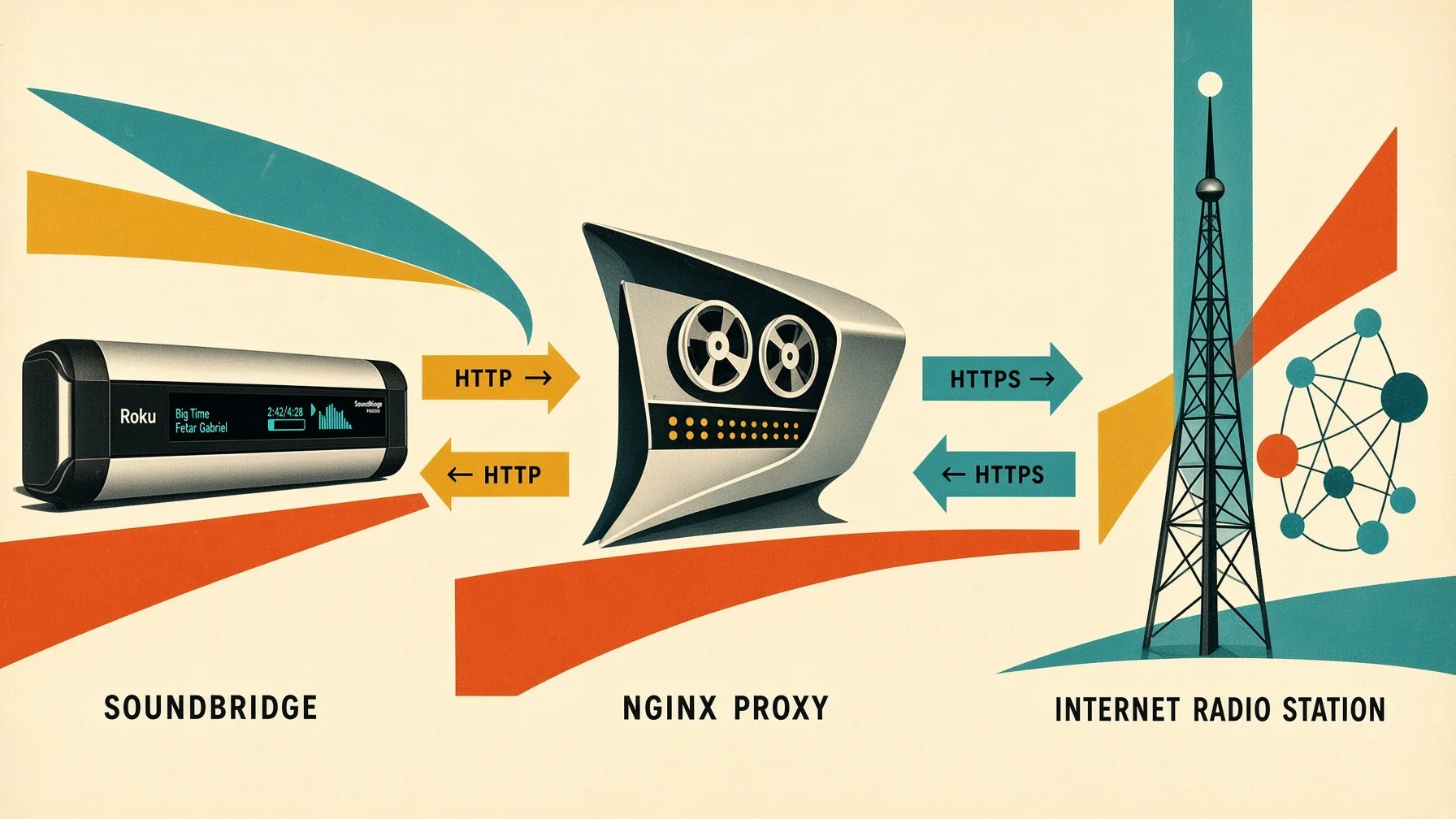
That separation was the key element of the entire solution. The SoundBridge therefore did not need to understand TLS or deal with the certificates used by the modern streaming server. From its perspective, the proxy was simply another network server on the local network. The modern encryption and all the associated requirements were handled entirely on the other side of the proxy.
Optimized for Streaming.
A normal web server does not necessarily have to be configured for maintaining a connection as a continuous data stream for hours at a time. For an Internet radio stream, however, that is exactly what is required. The server is not downloading a completed file. Instead, it continuously receives new audio data and immediately passes that data on to the client.
The NGINX configuration was therefore adjusted specifically for this purpose. Proxy buffering was disabled, as was caching. NGINX was not supposed to store the audio stream temporarily and then forward it in larger blocks. Instead, the incoming data should be passed to the SoundBridge as directly as possible.
The timeouts were also configured with longer intervals. A radio station does not terminate a connection simply because a complete file has not been transferred within a few seconds. The stream remains open and continuously delivers new audio data.
Various HTTP headers were also configured to improve compatibility with different streaming servers. These included a custom User-Agent and the forwarding of the Host header. NGINX was intended to identify itself clearly as an independent client to the radio station, while the SoundBridge continued to see a simple HTTP connection on the local side.
The configuration also included a simple health check. A separate local path could be used to verify whether the NGINX server itself was reachable. Although this was not necessary for audio playback, it made troubleshooting a running container considerably easier.

Conclusion.
The result was a surprisingly simple solution to a problem that initially appeared to make the SoundBridge obsolete. Instead of replacing the player with a modern streaming device, I was able to keep the original hardware in use and adapt it to the technical requirements of today's Internet radio.
What makes the solution particularly appealing to me is that the SoundBridge itself remains completely untouched. Its original firmware, hardware, display, controls, and audio architecture can continue to be used exactly as they were designed.
In other words, rather than replacing a perfectly good piece of hardware simply because the Internet around it has changed, the solution adapts the connection between the old device and the modern Internet.
And that is ultimately what makes the SoundBridge worth saving.
Check out this new great solution for your SoundBridge too
If you have any questions, please drop me a message!